Skip to content
TrendX

TrendX · Data & AI Product Studio

From public datato decisions.

A software studio that uses public data and AI to produce numbers people can base decisions on.

We build and run 14 apps ourselves, and validate our models on data they were never trained on — across accident risk, housing, heat and fitness.

Apps we build and runGoogle Play 13 · App Store 13
14
Public datasets combined7 auto-queried daily
20
Models validated on unseen dataAccident risk · Housing · Heat · Fitness
4 fields
Test cases passed identically on Android and iOSZipZatDae calculation spec
493

01 — What we do

Three pillars.

From the sea to the home, we build software that measures risk in numbers.

01

Product

Software we build and run ourselves

  • 14 mobile apps — designed, built, launched and operated in-house.
  • Open API integrations with public data from multiple ministries.
  • Delivered on iOS, Android and the web.
  • User support and updates handled directly.
  • Swift/SwiftUI
  • Kotlin/Compose
  • Supabase
02

Standards

Performance analysis on international standards

ISO framework based performance analysis — Hull & Propeller / Engine Performance Analysis.

  • Applying AI, machine learning and deep learning on top of international standards.

ISO 19030 · 15016 · 19847 · 19848

03

Ship-to-shore

Ship equipment integration & ship-to-shore communication

  • Integrating main engines, navigation equipment and monitoring & control systems over protocols such as Modbus, NMEA and ISO 19848.
  • Two-way communication with shore via satellite.
  • Platforms built to handle dropouts, retransmission and compression.

Modbus · NMEA · ISO 19848

02 — AI & data models

Adopted only when it beats the baseline.

  • Adopt a model only when it beats the baseline — and fix the adoption rule before training
  • We don't predict home prices — no public institution could explain the basis for such a number

Where do people who work here live?

Commute & residence demand model

Method
Explainable gravity-type choice model (conditional logit)
Data
Trained on 7.45 million people in National Pension Service open mobility data

Top-10 hit rate for residence areas, by workplace area

84 workplace areas in the Seoul metropolitan region · 5-fold spatial cross-validation by workplace district (scored on areas not used in training)

  • Conditional logitOur model56.2%
  • 10 nearest areas54.5%
  • Average distribution only18.6%
  • Model contribution +1.4 to +2.1 pp (95% CI) · log loss 4.328 → 3.468
  • A more complex model with no improvement (adding same-city / same-province variables) was rejected under the pre-set rule

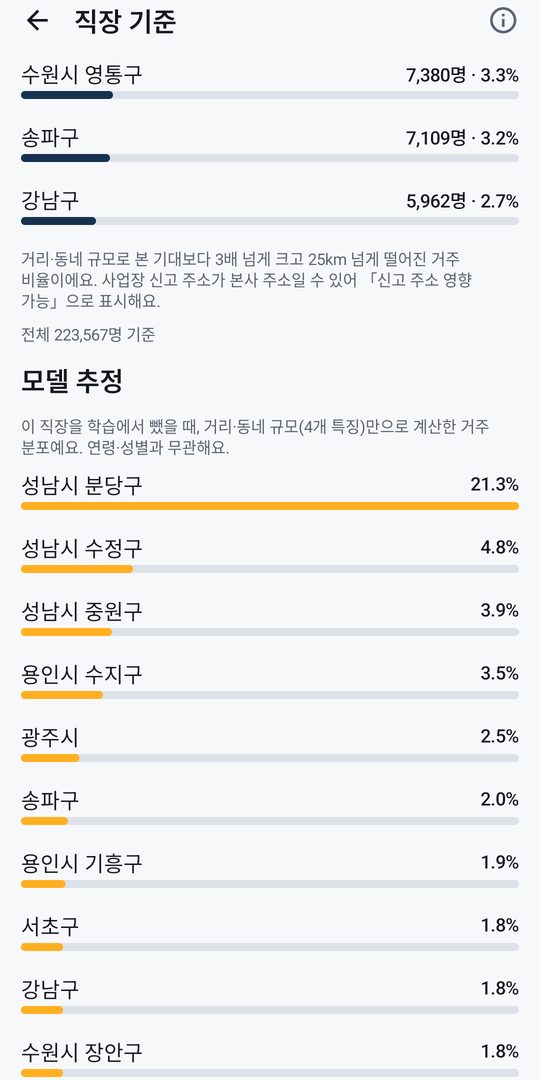
InZipZatDae 1.8.0 “Model estimate”

ZipZatDae app “Model estimate” screen — bars showing where people who work at one workplace live

What grade would you get at a test center today?

Fitness certification grade model

Method
Gradient boosting, 120 trees (scikit-learn)
Data
Trained on 251,748 measurement records with certified grades

Accuracy on 90,853 measurement records from 2025

Published side by side with three baselines

  • Gradient boostingAdopted86.7%
  • Rule on 3 core items75.0%
  • Simple percentile59.9%
  • Most common by sex & age group47.5%
  • macro F1 0.853 · 47.2% when inputs are shuffled
  • Validated with a split-trained model; deployed after retraining on the full period with the same settings
  • Trees exported as JSON so the browser runs the same calculation — Python↔JS probability difference 5×10⁻⁶

How many times higher is today's risk than usual?

Heatwave risk modelDeveloping

Method
Statistical model (conditional Poisson regression)
Data
29,762 heat-related illness cases (KDCA) × 97 KMA ASOS stations, 2011–2025

1.63×

Heat-related illness per 1 °C of apparent temperature · 95% interval 1.60–1.65

  • Trained on 2011–2023, validated on all 8,290 cases from 2024–2025
  • Log loss vs. baseline 2.1406 → 1.8972 · 100 label shuffles, p<0.01
  • Days beyond the training range (more than +3.8 °C above usual) are shown only as “N× or more”
  • Grades follow national criteria, not the model

InNalssi Salpim — Android · iOS

Accident risk prediction model

Method
Adopted after comparing Poisson, negative binomial, XGBoost and a neural network (MLP)
Data
Public accident statistics
  • Independently validated on years not used for training
  • Time-split validation — separate training and validation years to test predictive power on the future
  • Exposure-adjusted accident rates — removing the illusion that larger groups look riskier
  • Overdispersion model (negative binomial) · tree ensemble (XGBoost) · neural network, cross-compared
  • Data augmentation for rare events (CTGAN), compared
  • Shuffle and placebo controls to rule out chance
  • Weather-linked case-crossover analysis
  • Explainable risk-grade rules cross-validated against the model

Generative AI in production

All on Gemini
  • CaloryX — photo calorie & macro analysis · AI coach
  • BeautyCycle — photo analysis · schedule parsing
  • Jibwoon — AI feng shui site analysis
  • SafeCrew — translation, voice and subtitles in content production — 30 videos × 8 languages = 240 videos
Developing

Graph neural networks · spatio-temporal deep learning

A next-generation model that links movement and floating-population flows into a graph to forecast inter-regional demand over time

03 — Engineering, in numbers

From design to proof, in-house.

Every number comes straight from real operating and validation data.

Two platforms, one answer

ZipZatDae
493
Nalssi Salpim
270
Jikju prototype
55

One calculation-rule spec → Android and iOS must pass every test case identically before release.

Housing complexes loaded nationwide

337,733

Apartments 47,664 · officetels 20,250 · villas 269,819.

Seoul row-house & multi-family transactions: 2,463,939 (2006.1–2026.9)

Coordinates computed in-house

98.7%

Computed by matching parcels on the MOLIT building map (SHP) — no external geocoding.

Map display rate for Seoul row-house & multi-family homes traded in the last 3 years

First-screen web transfer

100KB

Models and maps load only at the step that needs them.

335 KB uncompressed · model 129 KB

Languages · RTL

17languages

Arabic and Urdu read right to left (RTL).

Nalssi Salpim in 11 languages — translations reviewed separately, 22 safety-message mistranslations fixed

Privacy by design

On-device

No sign-up or identity verification. Inputs are calculated only on the device, and property registers are read on the phone, so the documents never leave the device. Location is used once, on the device.

Public data combined

20datasets

11 Open API services · 9 file datasets, 7 queried automatically every day.

National Fitness 100: 531,202 measurement records · 33,962 facilities · 909,444 exercise prescriptions collected, cleaned and aggregated

Model validation methods

  • Time-split validation (unseen years)
  • Spatial cross-validation (unseen areas)
  • Baseline comparison
  • Adoption rules set before training
  • Shuffle & placebo controls
  • Limitations stated up front

Tools we build with

  • Swift/SwiftUI
  • Kotlin/Compose
  • Expo RN
  • Supabase · Edge Function
  • In-app subscriptions
  • MapLibre GL
  • scikit-learn
  • XGBoost
  • Gemini
  • Claude (AI dev tool)

04 — Apps we ship

14 apps, launched and running.

We handle planning, design, development, launch and operations ourselves. Google Play 13 · App Store 13Public store listings · 2026.10.07

05 — Programs

Technology built across programs.

Technology we built while taking part in programs across the public, financial and industrial sectors.

  1. AI & digital social problem-solving · Ministry of Science and ICT · NIA

    Nalssi Salpim — year-round personal safety alerts tailored to age, work and languageDeveloping

    What we built

    • Statistical model (conditional Poisson regression) — 1.63× per 1 °C of apparent temperature
    • 270 test cases passed identically on Android and iOS
    • 11 languages — 22 safety-message mistranslations fixed
  2. Public–private open innovation · National Pension Service data

    ZipZatDae commute proximity · commute & residence demand model

    What we built

    • Conditional logit — trained on mobility data for 7.45 million people
    • 5-fold spatial cross-validation, top-10 hit rate 56.2%
  3. G Valley · Korea Industrial Complex Corporation · Seoul Metropolitan Government

    ZipZatDae

    What we built

    • 337,733 complexes loaded nationwide · 98.7% of coordinates computed in-house
  4. Fintech · Financial Services Commission · Fintech Center Korea

    ZipZatDae deposit safety check · linking to deposit-return guarantees and jeonse loansDeveloping

    What we built

    • One calculation-rule spec · 493 test cases passed identically on Android and iOS
    • Property registers read on the phone
  5. Public data utilization · Korea Sports Promotion Foundation

    My Fitness, by My Neighborhood (web)

    What we built

    • Gradient boosting — 86.7% accuracy on 90,853 records from 2025
    • Same calculation in the browser · 100 KB first-screen transfer

06 — How we work

How we work.

Principles we have written down along the way.

  1. Combine public data → check for missing values and errors → validate on years not used in training → screens people use to decide

  2. Adopt a model only when it beats the baseline, and fix the adoption rule before training

  3. Grades follow national criteria, not the model — because we must be able to explain to users why they got that grade.

  4. When the sample is too small, we don't make up a number. We write “No transactions / Cannot be calculated.”

  5. Missing values on screen are never filled with 0 or averages; every screen shows its reference month, and data sources are gathered in an in-app guide

  6. We didn't invent what the data doesn't say

    We tried personalizing with machine learning, confirmed the measurements carried no prescription information, and used the actual prescription tallies as they are

  7. Two data sources are never blended into one number — each is used to verify the other

  8. Calculation rules are fixed in one spec, and Android and iOS must pass all 493 test cases identically before release — consistency for numbers used in financial decisions

  9. We don't stop at building the service — we give back to the institutions that provided the data

    Data-quality inquiries and feedback lists

  10. Industry domain knowledge and software engineering live under one roof, so nothing is lost between interpreting requirements and implementing them

  11. No listings, no ads. Only reported actual transactions — never asking prices

  12. A safety service built by people who know the risks in the field

07 — About

Who we are.

We bring industrial field domain knowledge and software development together.

Company
TrendX (트렌드 엑스)
CEO
Yoonseong Dan
Approach
From planning to data, Android, iOS, servers and operations — all done in-house

History

  1. Background

    Ship operations and ship software

    3 years as a merchant-marine 2nd engineer · 9 years developing ship software

  2. 2020.06

    First app “Exam Training Timer” released on the App Store

    Still in service

  3. 2026.07

    Vibe Massage · BeautyCycle · LocalSale · SafeCrew released

    NotiBox (Google Play)

  4. 2026.08

    CaloryX · Peekdo · GaslightGuard · JoyKade released

  5. 2026.09

    Jibwoon · Tripaint · ZipZatDae released

    Accident risk prediction model developed · nationwide apartment transaction data loaded (337,733 complexes)

  6. 2026.10

    Jikju (iOS) released · ZipZatDae 1.8.0 workplace-based home search

    Commute & residence demand model · “My Fitness, by My Neighborhood” web (fitness grade model)

  7. Now

    Nalssi Salpim heatwave risk modelDeveloping

Contact

If there's something you want to build.

Tell us the scope of the development you have in mind. We'll look at possible approaches with you — across apps, web, AI models and data analysis.

dys.trendx@gmail.com